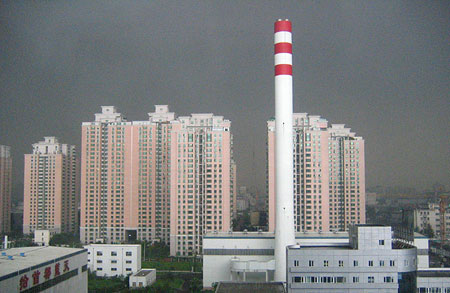
Yesterday I could have fetched a drink of water simply by waving a glass at the air. It was as if the whole city had been elevated into the clouds. There was a loss of visibility to buildings just across the square. I returned to the staff room feeling like I needed to towel dry; maybe next time I should change into swimming gear before heading out. And apparently, this is only the start. The students say terrifying things like, "you should see it in August."
Oh, neat.
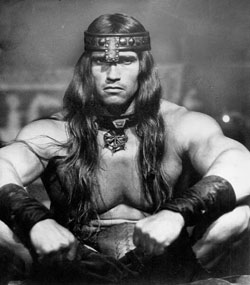
I suppose I should be glad I'm not in Tokyo then, where the ocean actually attempts to replace the air. It seems that when Tokyo got "sea," it forgot to sign up for the "breezes" that traditionally go with that. Consensus is that large buildings are to blame; as a certain barbarian might have commented, "how does the wind get in here?" Where's a certain monster when you need it?
---
The Japanese are characterised in the West as reserved people (some might say repressed): unfailingly polite, hiding their true feelings, never discussing taboo subjects. I can't speak to any empirical truth about such an observation except to look at the other end of the spectrum: the farther people repress themselves, the more spectacularly they explode when they finally go sailing over the edge of whatever weird planet they inhabit. You've probably heard this story. You might not have heard this one, which had us shaking our heads in simple disbelief.
But it's a different kind of repression I want to look at. Since the Occupation, Japanese society has been affirmedly pacifist. Left behind was the jingoism and the labyrinthine and militaristic politics of the 1930s. Not even Mr Koizumi, deploying Japanese troops overseas for the first time since the war, could dent this sentiment.
The bus ride from Yamagata to Sendai is about an hour, and it's quite deceptive. You're never sure exactly where Sendai is supposed to begin. You pass many signs suggesting the city will begin any time now, but it fails to eventuate. Then you go into a tunnel for a bit, and when you emerge, powering up the ramp into the daylight, you discover yourself in the centre of town. Oh, who put that there?
As the bus cruised down Hirose-dori, my attention was drawn to a small car coming the other way. You are familiar with this kind of car. Rodney Hide is familiar with this kind of car. Cramped, barely able to contain its two occupants, and with a roof devoted entirely to loudspeakers. There was a small Japanese flag sticker on one door, and the loudspeakers blared indistinct Japanese. Some local political candidate out canvassing. Good for him.
Following not far behind this car was a beige Volkswagen van, similarly covered in loudspeakers, similarly engaged, but this time with two stickers. OK, the guy has himself an entourage. I suppose it's not uncommon.
The third vehicle was a small bus, and now there was no way this was a simple local candidate. Local candidates do not encourage followings like this. Local candidates also generally don't drive buses with monster national flags plastered to their sides. What was going on?
When the fourth and final vehicle passed, I knew. Huge and black, the bus had, in addition to the many flag stickers, streaming from behind it two great banners. One was the Japanese flag. The other was black with a gold rosette - I knew this was related to the national coat of arms; I discovered later it was the Imperial Seal, abandoned after the war. Through the window I caught a clearer glimpse of the men within. One was old, with the look of a dogged traditionalist. The other was Classic Weasel: greasy slicked-back hair, with a cant to the shoulders and eyes that fair howled "dodgy." But did that, or the flags, or the stickers tell me what they were about? No.
That would have been the armbands. The ones with the flags on.
This was my first encounter with the ultra-nationalists. Because ultra-nationalism is actually illegal in Japan, they call themselves "The Emperor's Party," and their slogans consist of stuff like "We support the Emperor!" Oh, and driving down the street late at night playing old anthems very loud. This crew is mostly harmless, content to rage against the dying of the imperialist light.
Not so content are the crime gangs with similar leanings. In 1990, the Mayor of Nagasaki was shot and wounded after he suggested the Emperor bore some responsibility for World War 2. A handful of days before I arrived, a different Mayor of Nagasaki was gunned down by a well-known local gang. My eyes popped when I first heard this. Suddenly I was back in the 1930s and its world of nationalism and seemingly random political assassinations.
With any luck the closest I'll get to this crowd again will be a scratchy recording played outside my window at midnight.
Coming soon: "Oh Matsushima!" or, "How to cheat at haiku."
Thursday, June 28, 2007

Sunday, June 10, 2007
Travelling without moving
There is the image that persists these days of China as a country of bicycles. Twenty years ago this was still true; today, perhaps not so much. With rising industrialisation and growing affluence, the car has become much more popular. As a consequence, on some days it can be a bit of a mystery as to whether Beijing, a city which gains 100,000 new cars each year, is surrounded by hills (as an atlas might suggest) or not.
If you want an example of a Bicycle Country, look to Japan.
One of the first things I saw upon stepping off the shinkansen in Yamagata was a vast row of bicycles parked on the street. I thought these were perhaps some kind of public transport initiative, but they actually belonged to people conducting a variety of business in nearby shops. Later I encountered huge underground garages devoted entirely to two-tiered racks filled with bicycles. On the footpath one must constantly be aware of the bicycle traffic whizzing past (cycling on actual roads is a an adventurous form of suicide - more on this later).
These bikes range from state-of-the-art mountain stompers to Raleigh 20s, touching modern urban machines and 50s-style old lady bikes on the way. The urban things, the ones you see on websites surrounded by excitingly modern slogans, look at first glance just like a Raleigh 20; a closer inspection reveals full suspension, light construction and an ability to fold away. That's not to say that the Raleigh 20 loses out. There are plenty of chopped-up, modified examples of this ancient road crusader, outfitted with suspension and other shiny gadgets to bring them up to speed.
It's easy to see why many people turn to bicycles and massively-grouted public transport for their getting-around needs: driving in Japan is more fraught with peril than badly-prepared fugu. To start with, street lighting is minimal. The traffic lights are all out of sync; nasty snarl-ups are not uncommon. Throw in additional hazards like cyclists manoeuvring nearby in black clothes with no lights. Then consider actual driver behaviour.
People will think nothing of abruptly stopping mid-lane to attempt to turn right across two lanes of oncoming traffic. Indicator use is purely optional. Accelerating after the light goes green seems to be considered rude; however, accelerating through a red light is accepted practise. Woe betide any cyclist who braves these clogged arteries: there is actually no room allocated for them (in fact, the wide and well-marked cycle lanes of NZ are alien to everyone here). Cars drive on the left-hand side; this fundamental point of familiarity is at least present. While here, however, a car remains something behind the wheel of which I never intend to get.
---
It's a little unsettling how some people can remind you so strongly of others. So just to let you know: Chrissie, Belinda, Bronwen, there are Japanese people here who look just like you (Bronwen, she also wore the same clothes and glasses as you...it was very eerie). Also encountered: doubles of Kim Jong-Il and Don Brash (!). And one of my students looked so much like Chris Cornell I was expecting an impromptu rendition of Jesus Christ Pose. Maybe it was best for everyone that this did not happen.
---
Perhaps the best time I have had here was not the yakitori restaurant, a little mom & pop place soaked in atmosphere where they cook the food in front of you on a little fire; nor the karaoke amid a vast feast in a Korean restaurant in Kokobuncho, the entertainment district; but walking to the ward office to collect my gai-jin card (a little piece of plastic that prevents the police from arresting me and beating me up).
Something to understand about Japanese streets: they become very very small once you depart the main roads. So in a few paces from a busy road you can be in a peaceful little suburb, all stone walls, gardens and ramshackle houses. Also, and I don't know if this is because of the earthquake risk, there are no underground cables. Everything seems to be suspended above the street on poles. If you look up at the sky your view will be criss-crossed by many black lines.
This is what I did, staring at the sun through the dark lenses of my goggles, and at the power lines and jet contrails crossing in front of it, the massive TV masts on the nearby hill visible through a gap in the buildings, the train clattering across the huge raised concrete pylons of the rail line, rotor+ in my ears. The first time I went that way I waved to an old Japanese man repairing his fishing net outside his house; I was a little disappointed I didn't see him this time. I felt very comfortable in those streets; perhaps it was a reflection of home, scaled against the Japanese pace of life. One day I'll go back and wander randomly some more.
If you want an example of a Bicycle Country, look to Japan.
One of the first things I saw upon stepping off the shinkansen in Yamagata was a vast row of bicycles parked on the street. I thought these were perhaps some kind of public transport initiative, but they actually belonged to people conducting a variety of business in nearby shops. Later I encountered huge underground garages devoted entirely to two-tiered racks filled with bicycles. On the footpath one must constantly be aware of the bicycle traffic whizzing past (cycling on actual roads is a an adventurous form of suicide - more on this later).
These bikes range from state-of-the-art mountain stompers to Raleigh 20s, touching modern urban machines and 50s-style old lady bikes on the way. The urban things, the ones you see on websites surrounded by excitingly modern slogans, look at first glance just like a Raleigh 20; a closer inspection reveals full suspension, light construction and an ability to fold away. That's not to say that the Raleigh 20 loses out. There are plenty of chopped-up, modified examples of this ancient road crusader, outfitted with suspension and other shiny gadgets to bring them up to speed.
It's easy to see why many people turn to bicycles and massively-grouted public transport for their getting-around needs: driving in Japan is more fraught with peril than badly-prepared fugu. To start with, street lighting is minimal. The traffic lights are all out of sync; nasty snarl-ups are not uncommon. Throw in additional hazards like cyclists manoeuvring nearby in black clothes with no lights. Then consider actual driver behaviour.
People will think nothing of abruptly stopping mid-lane to attempt to turn right across two lanes of oncoming traffic. Indicator use is purely optional. Accelerating after the light goes green seems to be considered rude; however, accelerating through a red light is accepted practise. Woe betide any cyclist who braves these clogged arteries: there is actually no room allocated for them (in fact, the wide and well-marked cycle lanes of NZ are alien to everyone here). Cars drive on the left-hand side; this fundamental point of familiarity is at least present. While here, however, a car remains something behind the wheel of which I never intend to get.
---
It's a little unsettling how some people can remind you so strongly of others. So just to let you know: Chrissie, Belinda, Bronwen, there are Japanese people here who look just like you (Bronwen, she also wore the same clothes and glasses as you...it was very eerie). Also encountered: doubles of Kim Jong-Il and Don Brash (!). And one of my students looked so much like Chris Cornell I was expecting an impromptu rendition of Jesus Christ Pose. Maybe it was best for everyone that this did not happen.
---
Perhaps the best time I have had here was not the yakitori restaurant, a little mom & pop place soaked in atmosphere where they cook the food in front of you on a little fire; nor the karaoke amid a vast feast in a Korean restaurant in Kokobuncho, the entertainment district; but walking to the ward office to collect my gai-jin card (a little piece of plastic that prevents the police from arresting me and beating me up).
Something to understand about Japanese streets: they become very very small once you depart the main roads. So in a few paces from a busy road you can be in a peaceful little suburb, all stone walls, gardens and ramshackle houses. Also, and I don't know if this is because of the earthquake risk, there are no underground cables. Everything seems to be suspended above the street on poles. If you look up at the sky your view will be criss-crossed by many black lines.
This is what I did, staring at the sun through the dark lenses of my goggles, and at the power lines and jet contrails crossing in front of it, the massive TV masts on the nearby hill visible through a gap in the buildings, the train clattering across the huge raised concrete pylons of the rail line, rotor+ in my ears. The first time I went that way I waved to an old Japanese man repairing his fishing net outside his house; I was a little disappointed I didn't see him this time. I felt very comfortable in those streets; perhaps it was a reflection of home, scaled against the Japanese pace of life. One day I'll go back and wander randomly some more.
Sunday, May 27, 2007
I said, Effortless Segue!
(just forget about the last paragraph in the previous post, ok?)
Speaking of small, I have seen a glimpse of hell. The walls of the subway stations are covered in tiny tiles, maybe 9" tall by 3" wide. They line the cavernous stairwells and cover the hundreds of metres of hallway and platform. What's so hellish about tiles, you may ask.
Some poor bugger had to grout them all.
There must be at least fifty kilometres of grouting in each station. There are about twenty stations on the Sendai subway line.
There are some larger grout lines which at first led me to speculate that massive sheets of tiles had been prefabricated and then just rolled out and glued into place, held together by some kind of vulcanising agent. However, closer inspection revealed not rubber but actual ceramic cement. It was indeed all done by hand. Centuries of Buddhism paid off as teams of Zen artisans prepared to grout the distance between Auckland and Christchurch.
You might be thinking that the technologically-minded Japanese had some kind of Grouting Robot designed and constructed for the purpose of tiling their subway stations. You may be harbouring notions that Japan is filled with glittering machines of wondrous design and barely-fathomable purpose, making the lives of their masters easy and leisure-filled.
This is not the case. Japanese high technology is retarded.
My Internet connection has to be confirmed every time I wake up my computer. It constantly suffers little glitches because it is PPP (Point-to-Point Protocol) rather than DHCP (Doesn't Hack off Customers Persistently). Today, for no reason, it decided that my flatmate and I couldn't both use the Internet. Tomorrow, who knows? Maybe we'll have to build a small shrine on top of our network router.
The largest purveyor of technology in Sendai is a place called Yodobashi Camera. It is a truly monstrous department store, surrounded by tales of adventure in its labyrinthine pathways. It sells all manner of shiny electronic wizardry. Except, of course, for the device I needed to actually make my computer go. Japanese power sockets are two-slot affairs, completely incompatible with our three pins. In the store there was a huge wall of power adaptors. Surely among them was the one I needed? Well, no. A million adapters for Japanese power-users to take with them to other countries; the reverse situation isn't even considered. I had to go to the Apple Store and buy a part, only half of which I actually needed. Yeesh.
Our shower gives us unconditional hot-water affection. Our sink, on the other hand, is like some high-maintenance lover who leads you on and then abruptly gives you the cold shoulder. It's connected to some arcane heating device of dubious pedigree; there's no telling when hot water may be available. Running the tap for a while may or may not have any effect. My solution is to leave it for half and hour; if I'm ever reduced to burning incense in its honour, I'm just gonna tear it off the wall and put in a wood fire instead.
It's not all doom and gloom, though. Technology is applied in interesting ways that wouldn't occur to us in the West. Until next time, imagine this: full-suspension Raleigh 20
Speaking of small, I have seen a glimpse of hell. The walls of the subway stations are covered in tiny tiles, maybe 9" tall by 3" wide. They line the cavernous stairwells and cover the hundreds of metres of hallway and platform. What's so hellish about tiles, you may ask.
Some poor bugger had to grout them all.
There must be at least fifty kilometres of grouting in each station. There are about twenty stations on the Sendai subway line.
There are some larger grout lines which at first led me to speculate that massive sheets of tiles had been prefabricated and then just rolled out and glued into place, held together by some kind of vulcanising agent. However, closer inspection revealed not rubber but actual ceramic cement. It was indeed all done by hand. Centuries of Buddhism paid off as teams of Zen artisans prepared to grout the distance between Auckland and Christchurch.
You might be thinking that the technologically-minded Japanese had some kind of Grouting Robot designed and constructed for the purpose of tiling their subway stations. You may be harbouring notions that Japan is filled with glittering machines of wondrous design and barely-fathomable purpose, making the lives of their masters easy and leisure-filled.
This is not the case. Japanese high technology is retarded.
My Internet connection has to be confirmed every time I wake up my computer. It constantly suffers little glitches because it is PPP (Point-to-Point Protocol) rather than DHCP (Doesn't Hack off Customers Persistently). Today, for no reason, it decided that my flatmate and I couldn't both use the Internet. Tomorrow, who knows? Maybe we'll have to build a small shrine on top of our network router.
The largest purveyor of technology in Sendai is a place called Yodobashi Camera. It is a truly monstrous department store, surrounded by tales of adventure in its labyrinthine pathways. It sells all manner of shiny electronic wizardry. Except, of course, for the device I needed to actually make my computer go. Japanese power sockets are two-slot affairs, completely incompatible with our three pins. In the store there was a huge wall of power adaptors. Surely among them was the one I needed? Well, no. A million adapters for Japanese power-users to take with them to other countries; the reverse situation isn't even considered. I had to go to the Apple Store and buy a part, only half of which I actually needed. Yeesh.
Our shower gives us unconditional hot-water affection. Our sink, on the other hand, is like some high-maintenance lover who leads you on and then abruptly gives you the cold shoulder. It's connected to some arcane heating device of dubious pedigree; there's no telling when hot water may be available. Running the tap for a while may or may not have any effect. My solution is to leave it for half and hour; if I'm ever reduced to burning incense in its honour, I'm just gonna tear it off the wall and put in a wood fire instead.
It's not all doom and gloom, though. Technology is applied in interesting ways that wouldn't occur to us in the West. Until next time, imagine this: full-suspension Raleigh 20
Monday, May 21, 2007
Size Matters
I had my first Kids lesson today. I was reasonably terrified; we only got a single day's Kids training and no practice. Things went very smoothly, though. All you need to survive is a vague idea of what the lesson's about and a good imagination. Oh, and energy. Some of the older kids can be a bit shy, and we have to get them up and rocking with all manner of games. This lot thought my dancing across the room was reasonably hilarious; they gave me that small allowance.
On my way back to the staffroom I was assailed by a jazzed-up two-year-old who mimed fangs and went "Raaaaargh!" at me. Of course I grinned and went "Raargh!" back at her. It was incredibly cute. Poor Natalie had that child in her next class...she came back drenched in sweat. Such is the crucible that is the Chibiko course.
The best kind of classes so far are the 2-student ones where they both tear the lesson to shreds and stand dominant atop its ruined corpse. A lesson like that can turn a lacklustre day into a really good time.
---
If you plan on being in Japan for any length of time, be prepared for one terribly important thing: SMALL. All the little things in life are exactly that, little. Doorways, rooms and most significantly: food. Oh. My. God.
I go through a box of cereal in three days with modest portions. The bread comes in 8-slice bags (and it's all white...bowel cancer ahoy!). Want some fast food? You get maybe 10 chips in a pack. Delicious liquids in containers larger than one litre are unheard-of. Cheese is both rare and only 500g tops.
There is one saving grace in all of this (besides the really cool noodle packs): a place called Jupiter. It sells foreign foods. As soon as I get paid I am going in there to buy a packet of Tim-Tams and a big jar of Vegemite. I may eat it, or I may just smear it all over my body. I've yet to decide.
I had a really smart segue into another discussion, lined up and ready to go. Blowed if I can remember what it is, though.
On my way back to the staffroom I was assailed by a jazzed-up two-year-old who mimed fangs and went "Raaaaargh!" at me. Of course I grinned and went "Raargh!" back at her. It was incredibly cute. Poor Natalie had that child in her next class...she came back drenched in sweat. Such is the crucible that is the Chibiko course.
The best kind of classes so far are the 2-student ones where they both tear the lesson to shreds and stand dominant atop its ruined corpse. A lesson like that can turn a lacklustre day into a really good time.
---
If you plan on being in Japan for any length of time, be prepared for one terribly important thing: SMALL. All the little things in life are exactly that, little. Doorways, rooms and most significantly: food. Oh. My. God.
I go through a box of cereal in three days with modest portions. The bread comes in 8-slice bags (and it's all white...bowel cancer ahoy!). Want some fast food? You get maybe 10 chips in a pack. Delicious liquids in containers larger than one litre are unheard-of. Cheese is both rare and only 500g tops.
There is one saving grace in all of this (besides the really cool noodle packs): a place called Jupiter. It sells foreign foods. As soon as I get paid I am going in there to buy a packet of Tim-Tams and a big jar of Vegemite. I may eat it, or I may just smear it all over my body. I've yet to decide.
I had a really smart segue into another discussion, lined up and ready to go. Blowed if I can remember what it is, though.
Sunday, May 13, 2007
Off the rails
This should have been in the training manual: get a good night’s sleep. This is the kind of job where failure do so results in a day filled with wishes for death, whereas compliance leads to a day of joy and sparkles. Am I exaggerating? You decide!
There are no insects here. OK, that’s not strictly true…I think I saw one yesterday. Come on, this is spring! There should be squillions of insects! But no…not even in the apartment’s nooks and crannies. What’s going on?
In other news, I saw the sky today. As in blue sky. Normally the sky is white and the sunlight is just this diffuse glare that is everywhere at once, reflecting off every surface and making it basically impossible to keep your eyes open. There was a high wind, so I guess all the air pollution got blown away.
---
My first real panic was not long in coming. I’d been really proud of the way I’d negotiated the Tokyo transport network: Narita to Shinjuku; found the Nova office in Shinjuku; Shinjuku to Tokyo (even if it took me 20 minutes to figure out how to buy a train ticket). Tokyo, however, required me to catch the Shinkansen.
The Shinkansen will totally kick your ass. The literal translation is “New Trunk Line,” which is rather startlingly unpoetic, but from the moment you glimpse its icon in the train station, you are left in no doubt as to its nature. While buses and regular trains have somewhat pedestrian (haw haw!) icons, the Shinkansen one looks like a spaceship. It’s a circular front-on view that says “I mean business.” Long before you see the train, you know it’s coming; there’s a rush of displaced air that howls through the tunnel. Finally the beast arrives, slamming in to the station at 80 km/h, and what do you know, it even looks like a spaceship. You could go to Mars in one of these things.
Shinkansen trains have the punctuality of the Grim Reaper itself. Two minutes before time, BAM, it arrives, and then right on the minute, BAM, it roars off again. Woe betide the poor schmoe who doesn’t know exactly which train he wants or where it is arriving.
In other words, woe betide me.
There was absolutely no indication that this train was the right one beyond the fact that it was occupying that track at that time (this is good enough for the Japanese). There was every indication that it was the wrong one: the little LED sign on the carriage said “Sendai” when I wanted “Yamagata.” I got on board and sought out someone official. The nice girl at the canteen informed me that yes, this train was bound for Sendai and I should get on the one further up the platform. This was a sound plan for the 5 seconds before the doors hissed shut in my face and the train started moving.
Mild terror ensued.
A captain’s attention was attracted, and he explained that I should get off at the next station, scoot up the side of the train, and get in the right carriages; apparently in Japan they stick two trains together and split them up at a later point. So the train stops, I bail out and head up the platform, seeking my carriages. Ah, there they are! I’ll just get on this – BAM! Doors close, train gone. Frantic gestures to the elderly but stern platform guy are to no avail; the Shinkansen waits for no-one, least of all some poor fool gai-jin who doesn’t know what he’s doing.
At this point I entered light catatonia.
I thrashed round the station for a bit, panic rising, but after a minute I settled down and asked about the next train to Yamagata. The thirty minute interval passed quickly as I checked trains off the “Next Train” board. This time there would be no mistakes. This time I would stand in the right place and be on board in seconds.
The train, and more importantly the carriages I had to be on, blew by me without even slowing down. Um, what? Oh, I see, the Track # that I have to wait by actually extends for three platforms, and I need to be on the one waaaaay down there, where the train is stopping. Nice. One flat-out sprint later and I made it with a full sixty seconds to spare.
Efficiency is a hard task-master.
There are no insects here. OK, that’s not strictly true…I think I saw one yesterday. Come on, this is spring! There should be squillions of insects! But no…not even in the apartment’s nooks and crannies. What’s going on?
In other news, I saw the sky today. As in blue sky. Normally the sky is white and the sunlight is just this diffuse glare that is everywhere at once, reflecting off every surface and making it basically impossible to keep your eyes open. There was a high wind, so I guess all the air pollution got blown away.
---
My first real panic was not long in coming. I’d been really proud of the way I’d negotiated the Tokyo transport network: Narita to Shinjuku; found the Nova office in Shinjuku; Shinjuku to Tokyo (even if it took me 20 minutes to figure out how to buy a train ticket). Tokyo, however, required me to catch the Shinkansen.
The Shinkansen will totally kick your ass. The literal translation is “New Trunk Line,” which is rather startlingly unpoetic, but from the moment you glimpse its icon in the train station, you are left in no doubt as to its nature. While buses and regular trains have somewhat pedestrian (haw haw!) icons, the Shinkansen one looks like a spaceship. It’s a circular front-on view that says “I mean business.” Long before you see the train, you know it’s coming; there’s a rush of displaced air that howls through the tunnel. Finally the beast arrives, slamming in to the station at 80 km/h, and what do you know, it even looks like a spaceship. You could go to Mars in one of these things.
Shinkansen trains have the punctuality of the Grim Reaper itself. Two minutes before time, BAM, it arrives, and then right on the minute, BAM, it roars off again. Woe betide the poor schmoe who doesn’t know exactly which train he wants or where it is arriving.
In other words, woe betide me.
There was absolutely no indication that this train was the right one beyond the fact that it was occupying that track at that time (this is good enough for the Japanese). There was every indication that it was the wrong one: the little LED sign on the carriage said “Sendai” when I wanted “Yamagata.” I got on board and sought out someone official. The nice girl at the canteen informed me that yes, this train was bound for Sendai and I should get on the one further up the platform. This was a sound plan for the 5 seconds before the doors hissed shut in my face and the train started moving.
Mild terror ensued.
A captain’s attention was attracted, and he explained that I should get off at the next station, scoot up the side of the train, and get in the right carriages; apparently in Japan they stick two trains together and split them up at a later point. So the train stops, I bail out and head up the platform, seeking my carriages. Ah, there they are! I’ll just get on this – BAM! Doors close, train gone. Frantic gestures to the elderly but stern platform guy are to no avail; the Shinkansen waits for no-one, least of all some poor fool gai-jin who doesn’t know what he’s doing.
At this point I entered light catatonia.
I thrashed round the station for a bit, panic rising, but after a minute I settled down and asked about the next train to Yamagata. The thirty minute interval passed quickly as I checked trains off the “Next Train” board. This time there would be no mistakes. This time I would stand in the right place and be on board in seconds.
The train, and more importantly the carriages I had to be on, blew by me without even slowing down. Um, what? Oh, I see, the Track # that I have to wait by actually extends for three platforms, and I need to be on the one waaaaay down there, where the train is stopping. Nice. One flat-out sprint later and I made it with a full sixty seconds to spare.
Efficiency is a hard task-master.
Saturday, May 12, 2007
Getting there is only half the battle
Something I tell my new students, the ones I haven’t met before (which at this stage is all of them), is that I’ve never previously been overseas. That’s right, never even been to Australia. So bear that in mind as you read these pages; there’s going to be a lot of “gosh golly gee-whiz wow” about things that you might well think are old hat. Just bear with me on that. This, as the title suggests, is about the travels of a monkeyman. Monkey see, monkey report.
Takeoff is my favourite part of flying. The way the acceleration mashes you back in your seat, that feeling of being subject to extraordinary forces…I have to remember to relax and just let the hand of physics have its way. If I resist the effect is spoiled. Unfortunately it would seem that the larger the plane, the more this feeling is diminished. A 747 is so monstrous that you’re barely aware you’re accelerating at all. So my departure from familiar shores was not with a bang and a rush, but with a whisper. I would have liked a little more drama.
Flying internationally is, essentially, just like staying on the ground. You’re trapped in a noisy room with a whole load of other people for half a day, people with whom it’s quite hard to talk. You watch your plane magically traverse the face of the world on the big screen at the front of the cabin (at some point, after some brief geometry, I had the “Sam Gamgee in the cornfield” moment) . The giveaway that you’re actually flying is that at the end of the half day you step out and you’re somewhere else on the planet.
The single coolest thing about big international airports is the travelators. These are horizontal escalators; moving footpaths if you will. You walk on these as they themselves propel you forward; your velocity relative to the scenery is thus greatly increased. It must have been a kilometre or so from the exit gate at Changi to the main terminal, but my fellow passengers and I traversed this distance in just a few minutes. I wanted to go back and ride them again…and given that I had an extra hour to kill, thanks to a delay, I probably could have had I been thinking clearly.
I never had the impression, in Singapore, that I was in a place far distant from New Zealand. It was dark; the lights outside could have been any city. The terminal’s population was very diverse; I passed people from all over the world. I’d never seen anything like it except on TV, so since I was seeing it with my own eyes for the first time, I still couldn’t see it as proof that I was in Singapore.
The shops were all the same as in Auckland. I paid for things with dollars. The beer was familiar (even if the extortionate price was not). I would have to wait for dawn to get a sense of being somewhere else.
The approach to Japan could have been an approach to New Zealand, albeit from an odd angle. Volcanic peak with snow-capped mountains in the distance…hmmm, I find this strangely familiar. It wasn’t until I got closer that things began to look different, in a “gigantic neverending city with lots of air-pollution” kind of way. That was just a brief interlude however. Huge topiary bushes saying “Narita” notwithstanding, the place looked like the land around Taupo. Minus lake, of course. So that’s it, huh? Ladies and gentlemen, we have arrived.
Takeoff is my favourite part of flying. The way the acceleration mashes you back in your seat, that feeling of being subject to extraordinary forces…I have to remember to relax and just let the hand of physics have its way. If I resist the effect is spoiled. Unfortunately it would seem that the larger the plane, the more this feeling is diminished. A 747 is so monstrous that you’re barely aware you’re accelerating at all. So my departure from familiar shores was not with a bang and a rush, but with a whisper. I would have liked a little more drama.
Flying internationally is, essentially, just like staying on the ground. You’re trapped in a noisy room with a whole load of other people for half a day, people with whom it’s quite hard to talk. You watch your plane magically traverse the face of the world on the big screen at the front of the cabin (at some point, after some brief geometry, I had the “Sam Gamgee in the cornfield” moment) . The giveaway that you’re actually flying is that at the end of the half day you step out and you’re somewhere else on the planet.
The single coolest thing about big international airports is the travelators. These are horizontal escalators; moving footpaths if you will. You walk on these as they themselves propel you forward; your velocity relative to the scenery is thus greatly increased. It must have been a kilometre or so from the exit gate at Changi to the main terminal, but my fellow passengers and I traversed this distance in just a few minutes. I wanted to go back and ride them again…and given that I had an extra hour to kill, thanks to a delay, I probably could have had I been thinking clearly.
I never had the impression, in Singapore, that I was in a place far distant from New Zealand. It was dark; the lights outside could have been any city. The terminal’s population was very diverse; I passed people from all over the world. I’d never seen anything like it except on TV, so since I was seeing it with my own eyes for the first time, I still couldn’t see it as proof that I was in Singapore.
The shops were all the same as in Auckland. I paid for things with dollars. The beer was familiar (even if the extortionate price was not). I would have to wait for dawn to get a sense of being somewhere else.
The approach to Japan could have been an approach to New Zealand, albeit from an odd angle. Volcanic peak with snow-capped mountains in the distance…hmmm, I find this strangely familiar. It wasn’t until I got closer that things began to look different, in a “gigantic neverending city with lots of air-pollution” kind of way. That was just a brief interlude however. Huge topiary bushes saying “Narita” notwithstanding, the place looked like the land around Taupo. Minus lake, of course. So that’s it, huh? Ladies and gentlemen, we have arrived.
Subscribe to:
Posts (Atom)