Yesterday I could have fetched a drink of water simply by waving a glass at the air. It was as if the whole city had been elevated into the clouds. There was a loss of visibility to buildings just across the square. I returned to the staff room feeling like I needed to towel dry; maybe next time I should change into swimming gear before heading out. And apparently, this is only the start. The students say terrifying things like, "you should see it in August."
Oh, neat.
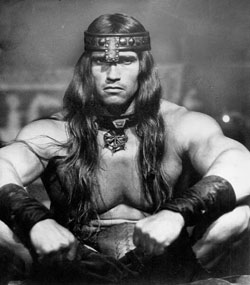
I suppose I should be glad I'm not in Tokyo then, where the ocean actually attempts to replace the air. It seems that when Tokyo got "sea," it forgot to sign up for the "breezes" that traditionally go with that. Consensus is that large buildings are to blame; as a certain barbarian might have commented, "how does the wind get in here?" Where's a certain monster when you need it?
---
The Japanese are characterised in the West as reserved people (some might say repressed): unfailingly polite, hiding their true feelings, never discussing taboo subjects. I can't speak to any empirical truth about such an observation except to look at the other end of the spectrum: the farther people repress themselves, the more spectacularly they explode when they finally go sailing over the edge of whatever weird planet they inhabit. You've probably heard this story. You might not have heard this one, which had us shaking our heads in simple disbelief.
But it's a different kind of repression I want to look at. Since the Occupation, Japanese society has been affirmedly pacifist. Left behind was the jingoism and the labyrinthine and militaristic politics of the 1930s. Not even Mr Koizumi, deploying Japanese troops overseas for the first time since the war, could dent this sentiment.
The bus ride from Yamagata to Sendai is about an hour, and it's quite deceptive. You're never sure exactly where Sendai is supposed to begin. You pass many signs suggesting the city will begin any time now, but it fails to eventuate. Then you go into a tunnel for a bit, and when you emerge, powering up the ramp into the daylight, you discover yourself in the centre of town. Oh, who put that there?
As the bus cruised down Hirose-dori, my attention was drawn to a small car coming the other way. You are familiar with this kind of car. Rodney Hide is familiar with this kind of car. Cramped, barely able to contain its two occupants, and with a roof devoted entirely to loudspeakers. There was a small Japanese flag sticker on one door, and the loudspeakers blared indistinct Japanese. Some local political candidate out canvassing. Good for him.
Following not far behind this car was a beige Volkswagen van, similarly covered in loudspeakers, similarly engaged, but this time with two stickers. OK, the guy has himself an entourage. I suppose it's not uncommon.
The third vehicle was a small bus, and now there was no way this was a simple local candidate. Local candidates do not encourage followings like this. Local candidates also generally don't drive buses with monster national flags plastered to their sides. What was going on?
When the fourth and final vehicle passed, I knew. Huge and black, the bus had, in addition to the many flag stickers, streaming from behind it two great banners. One was the Japanese flag. The other was black with a gold rosette - I knew this was related to the national coat of arms; I discovered later it was the Imperial Seal, abandoned after the war. Through the window I caught a clearer glimpse of the men within. One was old, with the look of a dogged traditionalist. The other was Classic Weasel: greasy slicked-back hair, with a cant to the shoulders and eyes that fair howled "dodgy." But did that, or the flags, or the stickers tell me what they were about? No.
That would have been the armbands. The ones with the flags on.
This was my first encounter with the ultra-nationalists. Because ultra-nationalism is actually illegal in Japan, they call themselves "The Emperor's Party," and their slogans consist of stuff like "We support the Emperor!" Oh, and driving down the street late at night playing old anthems very loud. This crew is mostly harmless, content to rage against the dying of the imperialist light.
Not so content are the crime gangs with similar leanings. In 1990, the Mayor of Nagasaki was shot and wounded after he suggested the Emperor bore some responsibility for World War 2. A handful of days before I arrived, a different Mayor of Nagasaki was gunned down by a well-known local gang. My eyes popped when I first heard this. Suddenly I was back in the 1930s and its world of nationalism and seemingly random political assassinations.
With any luck the closest I'll get to this crowd again will be a scratchy recording played outside my window at midnight.
Coming soon: "Oh Matsushima!" or, "How to cheat at haiku."



1 comment:
Thats just crazy, crazy.
It is jsut cold here, and then it becomes really humid for reasons passing understanding.
Join up with the ultra Nationalists and freak them out a little. It will be most fun, I assure you.
Post a Comment