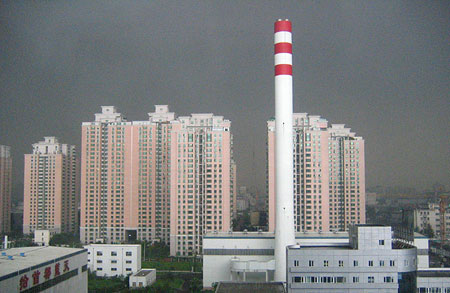
Yesterday I could have fetched a drink of water simply by waving a glass at the air. It was as if the whole city had been elevated into the clouds. There was a loss of visibility to buildings just across the square. I returned to the staff room feeling like I needed to towel dry; maybe next time I should change into swimming gear before heading out. And apparently, this is only the start. The students say terrifying things like, "you should see it in August."
Oh, neat.
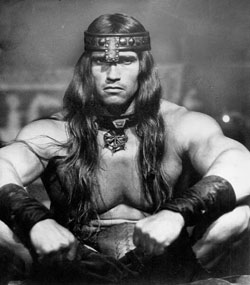
I suppose I should be glad I'm not in Tokyo then, where the ocean actually attempts to replace the air. It seems that when Tokyo got "sea," it forgot to sign up for the "breezes" that traditionally go with that. Consensus is that large buildings are to blame; as a certain barbarian might have commented, "how does the wind get in here?" Where's a certain monster when you need it?
---
The Japanese are characterised in the West as reserved people (some might say repressed): unfailingly polite, hiding their true feelings, never discussing taboo subjects. I can't speak to any empirical truth about such an observation except to look at the other end of the spectrum: the farther people repress themselves, the more spectacularly they explode when they finally go sailing over the edge of whatever weird planet they inhabit. You've probably heard this story. You might not have heard this one, which had us shaking our heads in simple disbelief.
But it's a different kind of repression I want to look at. Since the Occupation, Japanese society has been affirmedly pacifist. Left behind was the jingoism and the labyrinthine and militaristic politics of the 1930s. Not even Mr Koizumi, deploying Japanese troops overseas for the first time since the war, could dent this sentiment.
The bus ride from Yamagata to Sendai is about an hour, and it's quite deceptive. You're never sure exactly where Sendai is supposed to begin. You pass many signs suggesting the city will begin any time now, but it fails to eventuate. Then you go into a tunnel for a bit, and when you emerge, powering up the ramp into the daylight, you discover yourself in the centre of town. Oh, who put that there?
As the bus cruised down Hirose-dori, my attention was drawn to a small car coming the other way. You are familiar with this kind of car. Rodney Hide is familiar with this kind of car. Cramped, barely able to contain its two occupants, and with a roof devoted entirely to loudspeakers. There was a small Japanese flag sticker on one door, and the loudspeakers blared indistinct Japanese. Some local political candidate out canvassing. Good for him.
Following not far behind this car was a beige Volkswagen van, similarly covered in loudspeakers, similarly engaged, but this time with two stickers. OK, the guy has himself an entourage. I suppose it's not uncommon.
The third vehicle was a small bus, and now there was no way this was a simple local candidate. Local candidates do not encourage followings like this. Local candidates also generally don't drive buses with monster national flags plastered to their sides. What was going on?
When the fourth and final vehicle passed, I knew. Huge and black, the bus had, in addition to the many flag stickers, streaming from behind it two great banners. One was the Japanese flag. The other was black with a gold rosette - I knew this was related to the national coat of arms; I discovered later it was the Imperial Seal, abandoned after the war. Through the window I caught a clearer glimpse of the men within. One was old, with the look of a dogged traditionalist. The other was Classic Weasel: greasy slicked-back hair, with a cant to the shoulders and eyes that fair howled "dodgy." But did that, or the flags, or the stickers tell me what they were about? No.
That would have been the armbands. The ones with the flags on.
This was my first encounter with the ultra-nationalists. Because ultra-nationalism is actually illegal in Japan, they call themselves "The Emperor's Party," and their slogans consist of stuff like "We support the Emperor!" Oh, and driving down the street late at night playing old anthems very loud. This crew is mostly harmless, content to rage against the dying of the imperialist light.
Not so content are the crime gangs with similar leanings. In 1990, the Mayor of Nagasaki was shot and wounded after he suggested the Emperor bore some responsibility for World War 2. A handful of days before I arrived, a different Mayor of Nagasaki was gunned down by a well-known local gang. My eyes popped when I first heard this. Suddenly I was back in the 1930s and its world of nationalism and seemingly random political assassinations.
With any luck the closest I'll get to this crowd again will be a scratchy recording played outside my window at midnight.
Coming soon: "Oh Matsushima!" or, "How to cheat at haiku."
Thursday, June 28, 2007

Sunday, June 10, 2007
Travelling without moving
There is the image that persists these days of China as a country of bicycles. Twenty years ago this was still true; today, perhaps not so much. With rising industrialisation and growing affluence, the car has become much more popular. As a consequence, on some days it can be a bit of a mystery as to whether Beijing, a city which gains 100,000 new cars each year, is surrounded by hills (as an atlas might suggest) or not.
If you want an example of a Bicycle Country, look to Japan.
One of the first things I saw upon stepping off the shinkansen in Yamagata was a vast row of bicycles parked on the street. I thought these were perhaps some kind of public transport initiative, but they actually belonged to people conducting a variety of business in nearby shops. Later I encountered huge underground garages devoted entirely to two-tiered racks filled with bicycles. On the footpath one must constantly be aware of the bicycle traffic whizzing past (cycling on actual roads is a an adventurous form of suicide - more on this later).
These bikes range from state-of-the-art mountain stompers to Raleigh 20s, touching modern urban machines and 50s-style old lady bikes on the way. The urban things, the ones you see on websites surrounded by excitingly modern slogans, look at first glance just like a Raleigh 20; a closer inspection reveals full suspension, light construction and an ability to fold away. That's not to say that the Raleigh 20 loses out. There are plenty of chopped-up, modified examples of this ancient road crusader, outfitted with suspension and other shiny gadgets to bring them up to speed.
It's easy to see why many people turn to bicycles and massively-grouted public transport for their getting-around needs: driving in Japan is more fraught with peril than badly-prepared fugu. To start with, street lighting is minimal. The traffic lights are all out of sync; nasty snarl-ups are not uncommon. Throw in additional hazards like cyclists manoeuvring nearby in black clothes with no lights. Then consider actual driver behaviour.
People will think nothing of abruptly stopping mid-lane to attempt to turn right across two lanes of oncoming traffic. Indicator use is purely optional. Accelerating after the light goes green seems to be considered rude; however, accelerating through a red light is accepted practise. Woe betide any cyclist who braves these clogged arteries: there is actually no room allocated for them (in fact, the wide and well-marked cycle lanes of NZ are alien to everyone here). Cars drive on the left-hand side; this fundamental point of familiarity is at least present. While here, however, a car remains something behind the wheel of which I never intend to get.
---
It's a little unsettling how some people can remind you so strongly of others. So just to let you know: Chrissie, Belinda, Bronwen, there are Japanese people here who look just like you (Bronwen, she also wore the same clothes and glasses as you...it was very eerie). Also encountered: doubles of Kim Jong-Il and Don Brash (!). And one of my students looked so much like Chris Cornell I was expecting an impromptu rendition of Jesus Christ Pose. Maybe it was best for everyone that this did not happen.
---
Perhaps the best time I have had here was not the yakitori restaurant, a little mom & pop place soaked in atmosphere where they cook the food in front of you on a little fire; nor the karaoke amid a vast feast in a Korean restaurant in Kokobuncho, the entertainment district; but walking to the ward office to collect my gai-jin card (a little piece of plastic that prevents the police from arresting me and beating me up).
Something to understand about Japanese streets: they become very very small once you depart the main roads. So in a few paces from a busy road you can be in a peaceful little suburb, all stone walls, gardens and ramshackle houses. Also, and I don't know if this is because of the earthquake risk, there are no underground cables. Everything seems to be suspended above the street on poles. If you look up at the sky your view will be criss-crossed by many black lines.
This is what I did, staring at the sun through the dark lenses of my goggles, and at the power lines and jet contrails crossing in front of it, the massive TV masts on the nearby hill visible through a gap in the buildings, the train clattering across the huge raised concrete pylons of the rail line, rotor+ in my ears. The first time I went that way I waved to an old Japanese man repairing his fishing net outside his house; I was a little disappointed I didn't see him this time. I felt very comfortable in those streets; perhaps it was a reflection of home, scaled against the Japanese pace of life. One day I'll go back and wander randomly some more.
If you want an example of a Bicycle Country, look to Japan.
One of the first things I saw upon stepping off the shinkansen in Yamagata was a vast row of bicycles parked on the street. I thought these were perhaps some kind of public transport initiative, but they actually belonged to people conducting a variety of business in nearby shops. Later I encountered huge underground garages devoted entirely to two-tiered racks filled with bicycles. On the footpath one must constantly be aware of the bicycle traffic whizzing past (cycling on actual roads is a an adventurous form of suicide - more on this later).
These bikes range from state-of-the-art mountain stompers to Raleigh 20s, touching modern urban machines and 50s-style old lady bikes on the way. The urban things, the ones you see on websites surrounded by excitingly modern slogans, look at first glance just like a Raleigh 20; a closer inspection reveals full suspension, light construction and an ability to fold away. That's not to say that the Raleigh 20 loses out. There are plenty of chopped-up, modified examples of this ancient road crusader, outfitted with suspension and other shiny gadgets to bring them up to speed.
It's easy to see why many people turn to bicycles and massively-grouted public transport for their getting-around needs: driving in Japan is more fraught with peril than badly-prepared fugu. To start with, street lighting is minimal. The traffic lights are all out of sync; nasty snarl-ups are not uncommon. Throw in additional hazards like cyclists manoeuvring nearby in black clothes with no lights. Then consider actual driver behaviour.
People will think nothing of abruptly stopping mid-lane to attempt to turn right across two lanes of oncoming traffic. Indicator use is purely optional. Accelerating after the light goes green seems to be considered rude; however, accelerating through a red light is accepted practise. Woe betide any cyclist who braves these clogged arteries: there is actually no room allocated for them (in fact, the wide and well-marked cycle lanes of NZ are alien to everyone here). Cars drive on the left-hand side; this fundamental point of familiarity is at least present. While here, however, a car remains something behind the wheel of which I never intend to get.
---
It's a little unsettling how some people can remind you so strongly of others. So just to let you know: Chrissie, Belinda, Bronwen, there are Japanese people here who look just like you (Bronwen, she also wore the same clothes and glasses as you...it was very eerie). Also encountered: doubles of Kim Jong-Il and Don Brash (!). And one of my students looked so much like Chris Cornell I was expecting an impromptu rendition of Jesus Christ Pose. Maybe it was best for everyone that this did not happen.
---
Perhaps the best time I have had here was not the yakitori restaurant, a little mom & pop place soaked in atmosphere where they cook the food in front of you on a little fire; nor the karaoke amid a vast feast in a Korean restaurant in Kokobuncho, the entertainment district; but walking to the ward office to collect my gai-jin card (a little piece of plastic that prevents the police from arresting me and beating me up).
Something to understand about Japanese streets: they become very very small once you depart the main roads. So in a few paces from a busy road you can be in a peaceful little suburb, all stone walls, gardens and ramshackle houses. Also, and I don't know if this is because of the earthquake risk, there are no underground cables. Everything seems to be suspended above the street on poles. If you look up at the sky your view will be criss-crossed by many black lines.
This is what I did, staring at the sun through the dark lenses of my goggles, and at the power lines and jet contrails crossing in front of it, the massive TV masts on the nearby hill visible through a gap in the buildings, the train clattering across the huge raised concrete pylons of the rail line, rotor+ in my ears. The first time I went that way I waved to an old Japanese man repairing his fishing net outside his house; I was a little disappointed I didn't see him this time. I felt very comfortable in those streets; perhaps it was a reflection of home, scaled against the Japanese pace of life. One day I'll go back and wander randomly some more.
Subscribe to:
Posts (Atom)